Contents
In short
Driving in Morocco is manageable for a careful visitor. Traffic keeps to the right, speed limits are 60 km/h in town, 100 km/h on roads and 120 km/h on motorways, and police checks are frequent. In Marrakech, expect scooters and pedestrians everywhere, park outside the Medina and keep mountain roads for daylight.
We are Choumacars, a car rental agency based in Annajam, Marrakech, open 24/7 and rated 5/5 on Google. Every week we hand cars to visitors who are about to start driving in Morocco for the first time, at Marrakech Menara airport, at their hotel or at our office. Their questions are always the same: is it safe, how do the roundabouts work, where do I park near the Medina, what happens at a police check? This guide answers each of them with what we see on the road every day, and with links to official sources when a rule is involved.
Is driving in Morocco safe for tourists?
Driving in Morocco is safe for a calm, defensive driver who respects the limits and avoids night driving on rural roads. The difficulty is not the roads themselves, which are mostly tarmac and well signed between cities, but the mix of users sharing them.
The UK government travel advice for Morocco reminds visitors that road accidents are frequent, that poor lighting makes night driving more dangerous, and that secondary routes and mountain roads become hazardous in bad weather. It also warns about overloaded lorries overtaking on motorways without a hard shoulder. None of this should stop you renting a car. It simply tells you where to concentrate.
- In Marrakech: scooters, bicycles, pedestrians, horse-drawn carriages and donkey carts share the same lanes.
- On national roads: slow lorries, overtaking on blind bends, villages where the limit drops suddenly.
- In the mountains: hairpins on the Tizi n’Tichka and the roads to Imlil, with rockfalls after storms.
- At night: unlit vehicles, pedestrians and animals at the edge of the road.
Which side of the road do you drive on in Morocco, and what are the speed limits?
In Morocco you drive on the right and overtake on the left, and the general speed limits for cars are 60 km/h in built-up areas, 100 km/h on other roads and 120 km/h on motorways. These figures come from the road safety profile of Morocco published by the International Transport Forum (OECD), which also lists 30 km/h in some residential zones.
| Road type | General limit for cars | What you see in practice |
|---|---|---|
| Residential zones | 30 km/h where signed | Near schools and in some quiet streets |
| Built-up areas | 60 km/h | Often signed lower, 40 or 50 km/h, at village entrances |
| Other roads | 100 km/h | National roads such as the N9 to Ouarzazate |
| Motorways | 120 km/h | A7 towards Casablanca and towards Agadir |
Always follow the signs you see: limits change quickly, sometimes from 100 to 60 then 40 km/h within a few hundred metres as you enter a village. The rules themselves are set by Law 52-05 on the Highway Code, amended by Law 116-14, which the National Road Safety Agency (NARSA) publishes. The same sources state that seatbelts are compulsory and that hand-held phone use while driving is forbidden, with hands-free devices allowed.
What is traffic like in Marrakech?
Traffic in Marrakech is dense and mixed but slow, so the main skill is anticipation rather than speed. Most visitors adapt within the first half hour.
On the boulevards of Gueliz and Hivernage
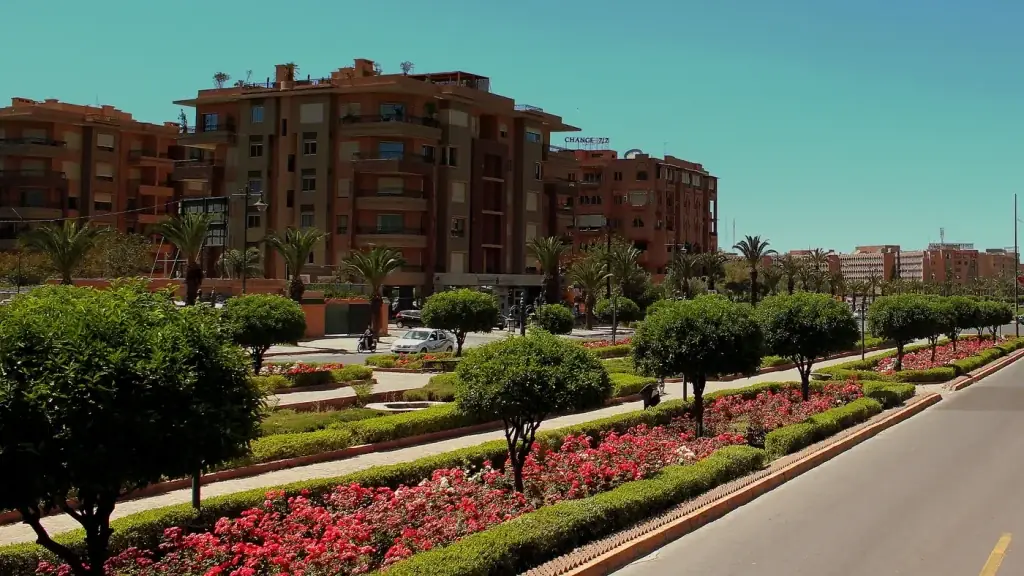
The modern districts have wide avenues, traffic lights and clear signs, often in Arabic and French. Avenue Mohammed V links Gueliz to the Koutoubia, and it is the axis most visitors use. Expect a scooter to slip past on either side when the light turns green, and taxis to stop suddenly to pick up a passenger. If you stay in this area, our page on car rental in Gueliz explains how we deliver there.
Around the Medina walls and the Koutoubia
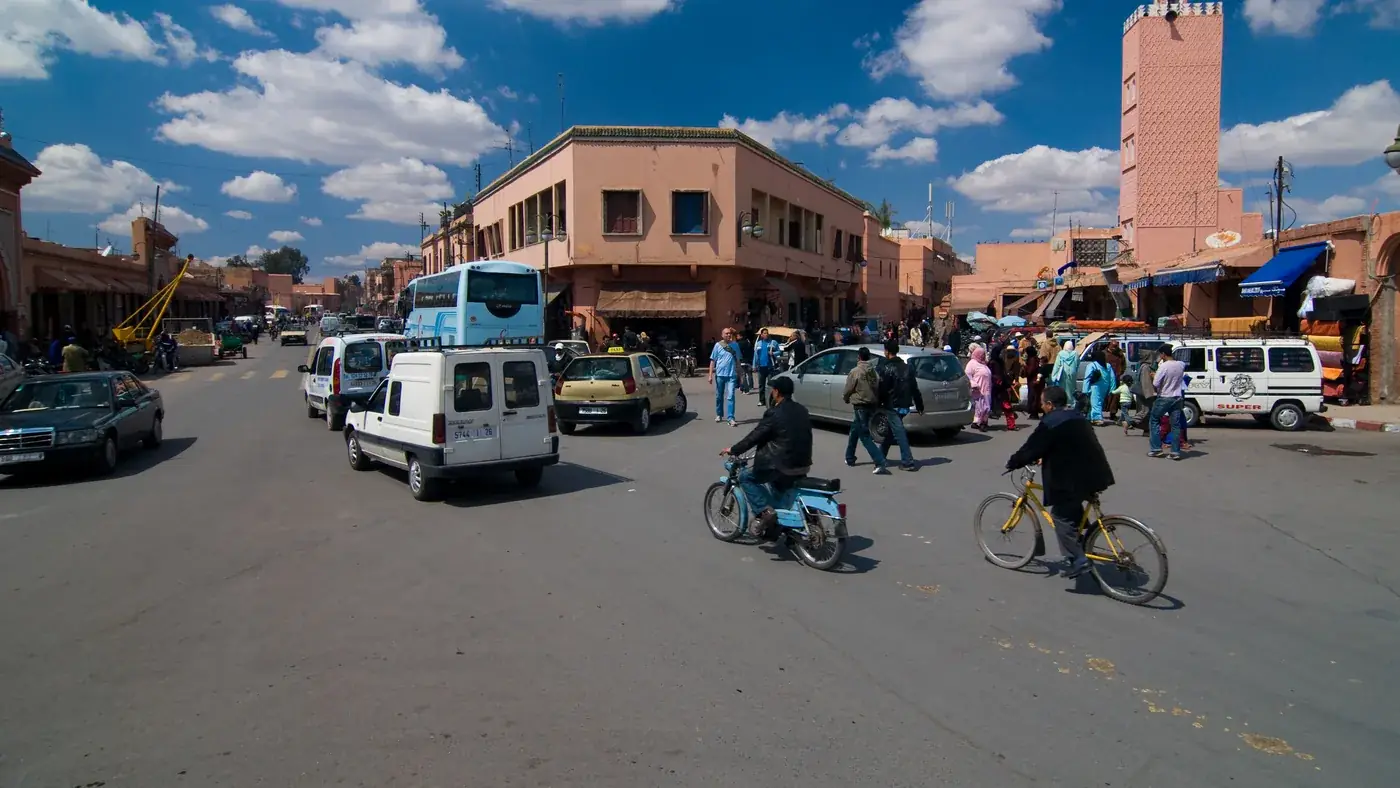
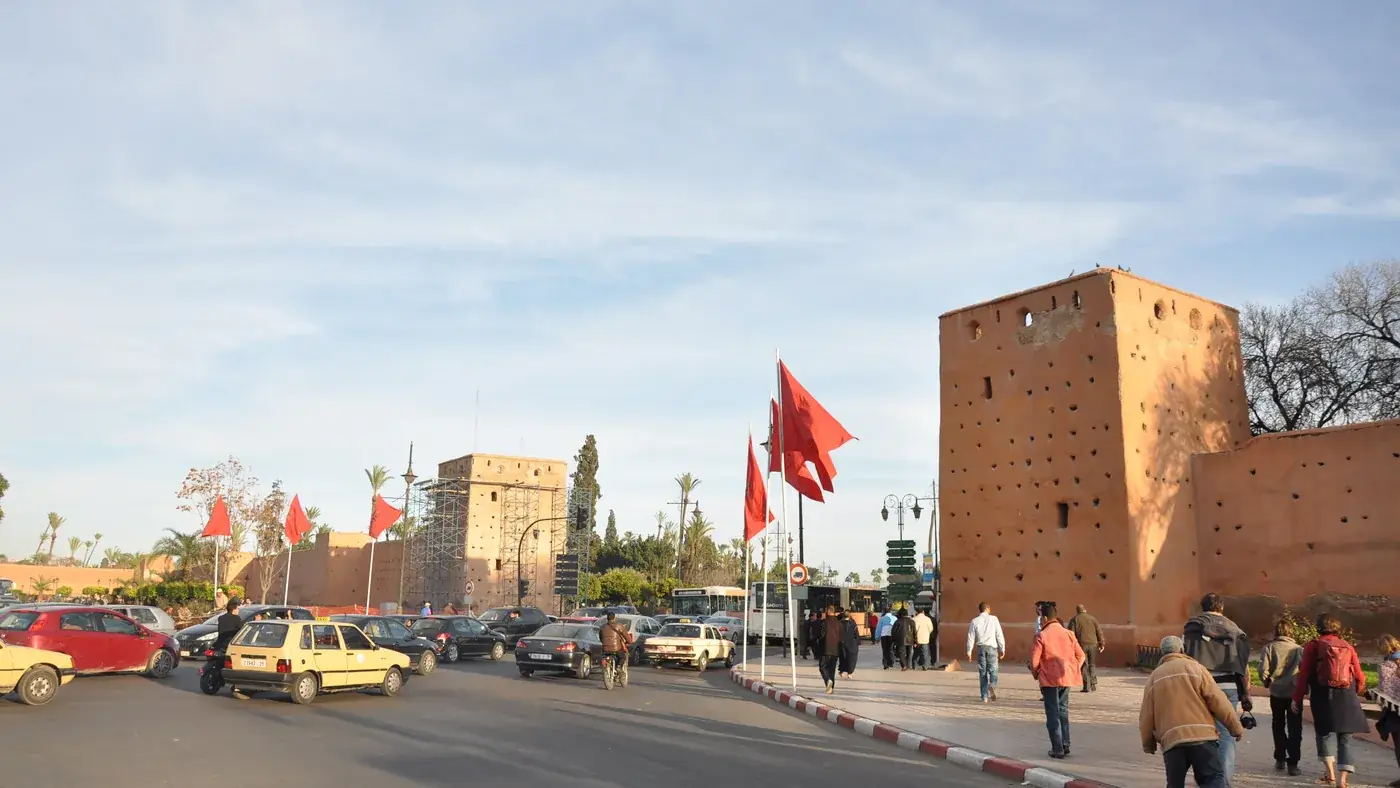
The ring of roads around the ramparts is the busiest part of town. Carriages wait near the Koutoubia, pedestrians cross wherever there is a gap, and delivery vans double-park. Drive slowly, keep your hands near the horn and leave space ahead.
Rush hours
The roads to Gueliz and the Medina are busiest in the morning and in the late afternoon. If you can, collect the car outside those hours for your first drive, or ask us to bring it to your hotel.
How do roundabouts and junctions work in Marrakech?
Roundabouts in Marrakech are easier if you watch what the other drivers actually do rather than assume a priority rule. The city has dozens of them, from the large ones on the boulevards to small ones in residential streets, and local habits are not uniform.
- Approach slowly and look at the car on your left, already on the roundabout, and the one about to enter.
- Enter when there is a real gap, not when you think you have priority.
- Keep to your lane as much as the traffic allows, and expect scooters on the inside.
- Signal your exit early and check your mirror for two-wheelers before you turn.
At junctions without lights, eye contact counts. A short horn tap is common and usually means “I am here”, not anger. When a police officer directs traffic at a junction, his signals override the lights.
Where can you park in Marrakech?
You can park easily in Gueliz, Hivernage and the Palmeraie, but you cannot drive inside most of the Medina, so plan to leave the car at its edge. Here is how it works district by district.
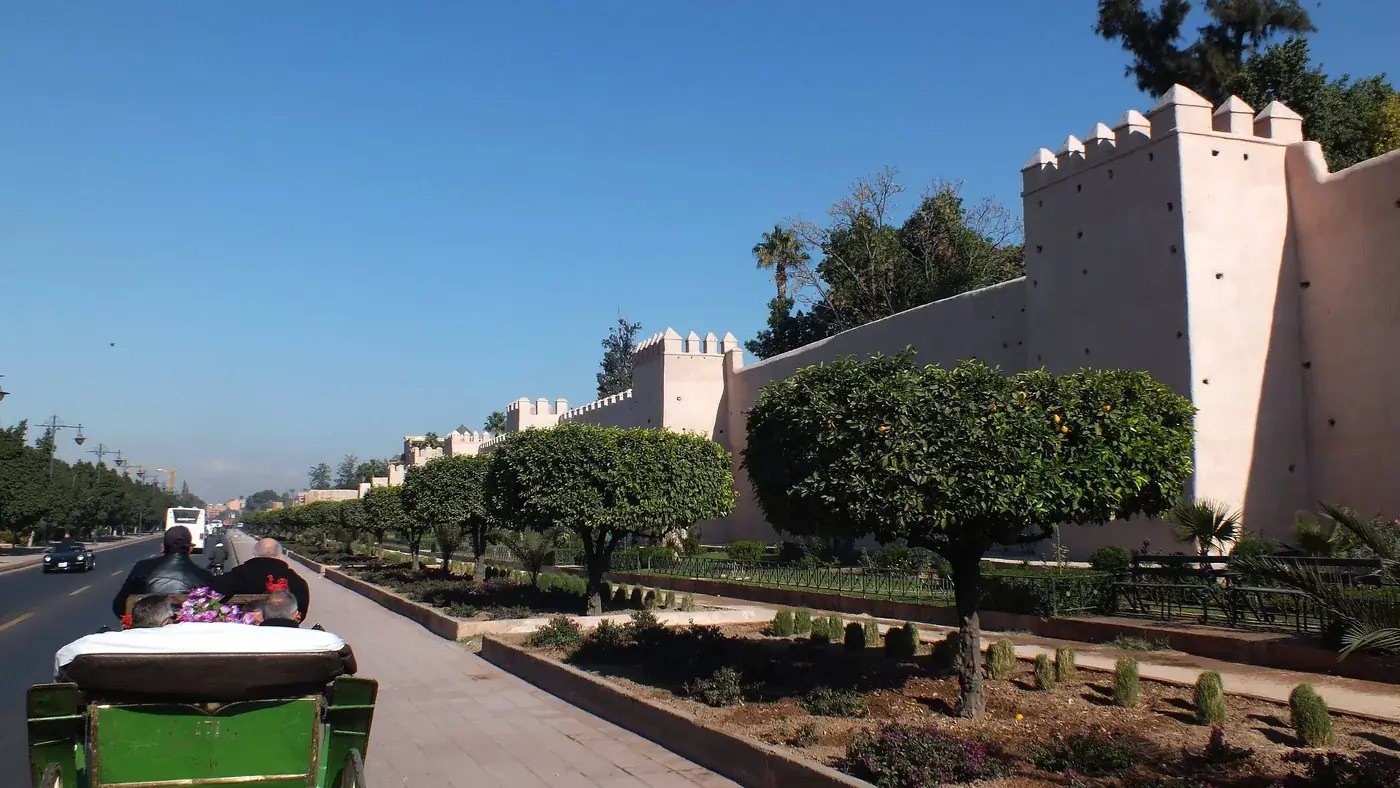
Near the Medina
The lanes of the Medina are too narrow for cars and many are closed to traffic. Use a public car park near one of the gates, such as the one at Bab Doukkala, or ask your riad which car park they use. Many riads are a short walk from a gate, and some send someone to help with luggage.
Gueliz and Hivernage
Street parking is common. You will often meet a parking attendant in a high-visibility vest who watches the cars on a stretch of street. Locals usually give a small tip when they leave. Avoid kerbs painted in red and white, which mark no-parking zones.
Palmeraie and large hotels
Villas and hotels in the Palmeraie and on the Ourika road usually have private parking. Check with yours before you arrive, and ask if the gate is staffed at night.
What happens at a police check in Morocco?
A police or gendarmerie check is a short, routine stop where officers look at your documents and sometimes your speed, and it usually lasts a few minutes. Checks are frequent at town and village entrances, often with a radar a little before.
- Slow down as soon as you see the stop sign or the officers at the roadside.
- Stop if you are waved over, switch off the engine and stay polite.
- Show your driving licence, your passport or national ID and the vehicle documents.
- If you are told of an offence, ask for an official receipt for any fine.
The gendarmerie covers roads outside towns, the police covers urban areas. Both are used to checking foreign drivers.
What documents do you need for driving in Morocco?
To drive a rental car in Morocco you need your driving licence, a passport or national ID, and the vehicle documents provided with the car. Some nationalities also need an International Driving Permit.
The GOV.UK page on International Driving Permits states that Morocco requires the 1968 permit for drivers with a GB or Northern Ireland licence, and the travel advice adds that it cannot be bought in Morocco: get it before you fly. Other countries have their own rules, so check with your licensing authority. Our article on the driving licence and documents to rent a car in Morocco covers each case in detail.
At Choumacars, the conditions are the same for every model: you must be at least 22 and have held your licence for at least 2 years.
What should you do in an emergency or after an accident?
After an accident in Morocco, make the area safe, call the emergency services if anyone is hurt, then call your rental agency before signing anything. According to the GOV.UK emergency guidance for Morocco, the numbers are:
- 150 for an ambulance or the fire service;
- 190 for the police;
- 177 for the gendarmerie, on roads outside towns.
For a collision without injury, drivers complete a joint report called a “constat amiable”, signed by both parties, as the GOV.UK advice explains. Take photos of the scene, the vehicles and the other driver’s documents. Our team answers on the phone and on WhatsApp 24/7 and tells you the next steps for the car.
Is a manual or an automatic better for driving in Morocco?
An automatic is the easier choice for driving in Morocco if you are not used to heavy stop-and-go traffic, because it leaves your attention free for scooters and pedestrians. A manual is perfectly fine if you drive one every day at home.
Most of the Choumacars fleet is automatic: the Hyundai Grand i10, the Hyundai Accent, the Renault Clio 5 automatic, the Renault Arkana, the Hyundai Tucson, the Audi A3, the Volkswagen Touareg and the Range Rover Sport. The Dacia Logan and one version of the Clio 5 are manual. For city stays, the Renault Clio 5 is easy to park in Gueliz and comfortable on the motorway. See all the options on our page about automatic car rental in Marrakech.
What do local drivers advise for driving in Morocco?
Local drivers would tell you to drive predictably, plan your route before you start and never rush in town. These are the tips our team gives at every handover:
- Mount your phone on the dashboard and set the route before you move. Download offline maps for the Atlas valleys, where the signal can drop.
- Keep a steady speed. Sudden braking surprises the scooter behind you more than a slow car does.
- Use the horn lightly to signal your presence on blind corners in the mountains.
- Fill up before leaving Marrakech for the Atlas: stations are further apart once you climb.
- Leave early for long drives so you arrive before dark.
- Keep small change for parking attendants.
- In winter, check whether the Tizi n’Tichka is open before you set off towards Ouarzazate.
What mistakes should you avoid when driving in Morocco?
The most common mistakes are driving at night outside towns, ignoring the speed changes at village entrances and trying to enter the Medina by car. Here is the full list we see most often:
- Speeding at a village entrance, where radar checks are common.
- Driving mountain roads after dark or in a storm.
- Assuming priority at a roundabout instead of watching the other cars.
- Leaving bags or documents visible inside the parked car.
- Holding the phone at the wheel.
- Forgetting the International Driving Permit when your country requires one.
- Underestimating the driving time to the south: allow for bends, villages and photo stops.
How does Choumacars help first-time drivers in Marrakech?
Choumacars helps first-time drivers by delivering the car where it is easiest to start, walking around it with you and staying reachable 24/7. A member of our team can meet you at the exit of the Marrakech Menara terminal, day and night, with the car ready. If your flight is delayed, we move the handover to your new arrival time. We can also bring the car to your hotel, to your villa in the Palmeraie or to the gate nearest your riad, anywhere in Marrakech and the surrounding area.
At handover, we walk around the car with you and take photos of its condition. Insurance is included and mileage is unlimited. A second driver can share the wheel on the same conditions as the main driver: at least 22 years old and a licence held for at least 2 years. Arriving by plane? See our car rental at Marrakech airport.
Frequently asked questions
Is driving in Morocco difficult for a first-timer?
Driving in Morocco takes a short adjustment. Traffic in Marrakech is dense and mixed, with scooters, carriages and pedestrians, but speeds in town are low. Start outside rush hour and choose an automatic if you can. Choumacars can deliver the car to your hotel so you skip the busiest streets on day one.
What are the speed limits in Morocco?
The general limits for cars are 60 km/h in built-up areas, 100 km/h on other roads and 120 km/h on motorways, according to the ITF road safety profile of Morocco. Signs often set lower limits at village entrances, where radar checks are frequent, so always follow the posted limit.
Do I need an International Driving Permit in Morocco?
It depends on the country that issued your licence. GOV.UK states that drivers with a GB or Northern Ireland licence need the 1968 International Driving Permit in Morocco, and that it cannot be bought there. Choumacars asks for a licence held for at least 2 years and a passport or national ID.
Can I drive into the Marrakech Medina?
Not into the narrow lanes, which are closed to cars or too tight. Park in a public car park near one of the gates, or ask your riad which car park it uses, then walk. Choumacars can hand the car over at the gate closest to your riad.
Is it safe to drive at night in Morocco?
In Marrakech, night driving is fine with care. Outside towns, avoid it where possible: the GOV.UK advice notes that poor lighting makes it dangerous, with pedestrians and animals on the road. Plan long drives, especially over the Tizi n’Tichka, so you arrive before dark.
What number do I call after an accident in Morocco?
GOV.UK lists 190 for the police, 177 for the gendarmerie outside towns and 150 for an ambulance or the fire service. Then call your rental agency before signing anything. The Choumacars team answers on the phone and WhatsApp 24/7.
What should I keep in the car at all times?
Keep your driving licence, your passport or national ID, any International Driving Permit you need and the vehicle documents. Police and gendarmerie checks are common at town entrances and officers will ask for them. Never leave them visible when you park.
Ready for driving in Morocco?
Tell us your dates and where you are staying, and we will suggest a car suited to the city and the roads beyond. Start from our car rental in Marrakech page, then read our guide to road trips from Marrakech by rental car to plan your first day out.